Easy ways Koi Fish Culture and Success

11:03 AM 0
Koi fish farming that is both attention spawning techniques include spawning ponds, koi mother superior, available forage seed and intensive care.

Parent Selection Koi way

Koi

Select the parent koi mature mature sex and the body. Mature sex which already produce sperm male parent and a female parent already produce mature eggs. The body is physically mature they are ready to become productive parent.

Koi

Physical prime, is not handicapped, fins and scales complete. Graceful movements, balance, not sluggish. Minimum 2 years of age males, females at least 3 years. Females are larger than males, stomach look bigger than the back. Males conversely more slender and flat stomach when viewed from the back. Male parent fins ready to mate will appear white spots.

A female parent pairs with 2 or 3 male parent. This is no longer a male preserve that mut. By providing a stock of more than one male, spawning failures can be avoided.

Not recommended to use the most good parent, because the offspring are usually ugly. Offspring is not necessarily as good as the parent. Select koi mediocre, but still has superior properties, such as solid color. If the seed selection can later choose which one is best.

Terms pool Spawning Koi

Made a separate spawning pond with a garden pond. Spawning ponds must have entrances and exits of its own water. The entire pool should be plastered and can be dried.

Spawning ponds vary widely. For an area of ​​3-6 m2 may narrow with a depth of 0.5 m. The location is an enough sunlight, not too noisy, protected from the reach of children and pets.

Provide also an egg hatching and seed treatment. Swimming hatching, the shape can be rectangular or round. If spherical diameter of 1.5 to 2 m.

Add the pool again if there is, that pool to grow natural food supply is used to feed the seeds if the yolk has been depleted. Pool depth of about 30 cm. Wide pool between 6-10 m2, sufficient.

The walls can be covered with a vinyl pool is the usual material for making fiberglass tubs. With a vinyl coating, the pools were more assured of cleanliness and the effects of cement can be eliminated.


Koi Pond Preparation

Swimming dried in the sun, the entrance filter installed to prevent eggs that may be washed away.

Typically koi will lay eggs under the plant or any material that could be used to attach the egg. Therefore provide sufficient engaging egg so that the egg can survive koi.

Engaging members can use kakaban eggs, which are used for spawning carp. Kakaban made from fibers that held by bamboo and nailed. Good Kakaban made of palm fiber and average length, length 120 cm width 40 cm. Kakaban adjust to a large number of females, 4-6 pieces for every 1 kg of the female parent.

In order to float, kakaban arranged on a piece of bamboo that are still intact. Above kakaban given bamboo and tied so that collection kakaban not be scattered when the parent pair spawn. Before install, kakaban cleaned, washed and rinsed to be free of mud.

Kakaban installed after the pool filled with water. Water always flows into the spawning pond for koi merangasang pair to spawn. In addition to engaging eggs kakaban place could use aquatic plants such as Hydrilla prepared or piece of rope as a substitute fibers.

Koi Fish Spawning implementation
Easy ways Koi Fish Culture and Success

Parent inserted around 16.00 and will begin to spawn midnight. The mother will swim around the pool with a male parent followed behind. Increasingly, their movements more exciting. Attaching the male parent body when following the female parent. At its peak, the mother will spend the eggs with the occasional jump into the air. The female activity followed immediately by removing the male semen.

The eggs were exposed to sperm will stick to the egg engaging kakaban or other material and difficult to be separated. Also there are some eggs fall to the bottom of the pool. Marriage finished in the morning. Parent immediately separated from the egg. If terlambatm eggs can be consumed by the mother.


There are two ways to separate the parent of eggs produced. First, the parent of the spawning pond and keep the eggs hatch in the pond. The second way to move the eggs to a hatchery pond. The first way is more practical because the savings pool.

By : Decorative Fish

Caring for and Maintaining Ornamental Fish Koi Good

3:44 AM 0
Caring for and maintaining good Koi fish a must for hobbyists. Basic staple to keep in mind is an appropriate, within their water and feeding techniques.

The Koi fish pond Matches


Koi fish can be kept in the pool cement, ground pools, garden ponds. Memeliharaan koi fish in the aquarium is not recommended. Because koi need a broad and deep swimming area. In addition, koi beauty lies in the colorful back. If elegance is maintained in the tank body and the color does not look up.
Maintaining Koi

Koi pond size is recommended at least 1.5m x 2m depths of 80-50cm. If pools are too shallow, the fish bodies will be constantly in contact with sunlight. Too much sun can change the color of koi body so pale and stunted growth.

Noteworthy distance to the lip of the pool water of at least 25cm is useful to prevent koi jump to the mainland. Swimming should be equipped sewer at the bottom. At the top of an installed pipes to deliver clean water that has been deposited.


Water For Good Fish Coins

Koi Fish

Filter four layers need to be installed to maintain cleanliness and smooth supply of water. Filters are four layers

- The first filter is composed of gravel, sand, and palm fiber filter function littering rubbish and mud pools.
- The second form of carbon zeolite filter function removes toxins, odor, and kill germs.
- The third filter in the form of non-lethal pesticide-degrading bacteria that play a role in the process of water purification pond.
-Filter Fourth form of plants or rocks that can bind to dirt.

Koi Tiger

The degree of acidity (pH) of water that is suitable for the growth of koi is from 6.5 to 8.5. To maintain the water circulation pump can be installed capable of delivering as much as 25 liters of water per minute. In this way, the pool water does not need frequent cleaning, but need to clean the filter and filter tub. How, spray filters with clean water about 5-10 minutes.

When using this filter, you should do the replacement of water every two weeks. The goal is to get rid of toxic substances from the leftovers are decomposed into nitrite are harmful to fish health.


Koi Fish Feeding way

Two Koi

Feed serves to form an ideal body and brighten colors in koi fish, as well as its medium for treating sick koi fish. The type of feed given feed can be natural or artificial feed. The feed contains nutritionally balanced according to the needs of koi fish. Feed should be given twice a day, morning and evening so that the fish's nutritional needs are met.

The type of feed used to spur the growth of koi fish that ideal body is wheat germ. The feed is made of materials containing high protein such as, wheat, shrimp, fish meal and soybean meal.

Protein content of about 32%. Besides wheat germ also contains vitamins A, D, E, K, B2, B6, B12, niacin, vitamin C and other mineral elements such as calcium, choline chloride, panthetonate, trace minerals, and antioxidants.
Koi Badut

Meanwhile, the feed to brighten / sharpen the color of koi is feed containing carotene. These substances can stimulate the appearance of color in koi fish. Naturally in the body there is a substance koi carotene form of antaxanthin produce a red color, and lutein creating a yellow-green color.

Koi fish feed containing such substances carotene; carrots, algae or algae Spirullina, and Chlorella, watermelon, cabbage, cabbage and green peppers. While the animals can be given feed of crabs, crustaceans, krill, trout, salmon, water fleas, mosquito larvae, worms hair, and blood worms. according to sources.

By : Decorative Fish

Ornamental fish Salmon

10:36 AM 0
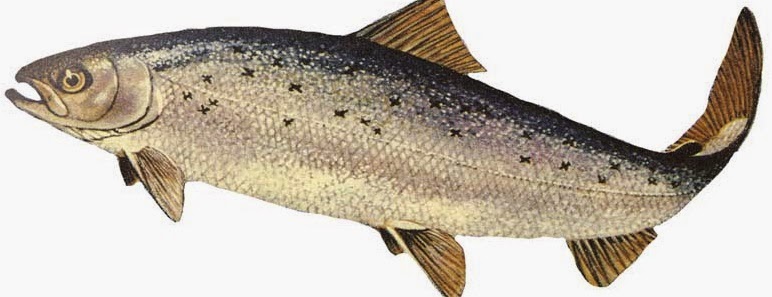
Salmon is a kind of marine fish of the family Salmonidae. Another fish that a family with salmon is a fish Trout. The difference is the live migration of salmon compared with sedentary trout. Salmon live in the Atlantic Ocean and the Pacific Ocean.

In general, salmon are anadromous species, ie species that migrate to breed. Salmon born in freshwater, migrate to the ocean, then return to fresh water to reproduce. There is a belief that the salmon always go back to the same place where he was born to breed. Research suggests so, but the reason why it happens and how salmon can save memory is still a mystery.
Salmon returning to fresh water rushing waters to breed. Navigation method does the sense of smell may be done with the fish. Half of adult salmon will die within a few days to weeks after breeding.

Salmon

To put the egg, the female salmon flapping its tail to create a low-pressure area to remove gravel that swept away, creating a gap for him to put the eggs. One gap can accommodate 5,000 eggs, covering an area of ​​about 2.8 m2. Egg color varies from orange to red. One or more males will approach the female salmon and eject sperm into the water to fertilize the egg. Salmon females then cover the eggs with a whisk laying on the gravel and then go somewhere else. Salmon female can do it seven times before the eggs in her ovaries out. Salmon will die of fatigue shortly after laying.


Eggs should be placed under the gravel around the water cooler with a good flow as the supply of oxygen. High mortality is common at this stage, which is largely caused by predation and changes in water conditions caused by human activities.
Salmon

The young salmon in freshwater settled the place they were born, for three years before migrating to the ocean. During this period, they are silvery. It is estimated that only 10% of the number of eggs that survived reach this stage.
Red Salmon

Salmon spend over one to five years before reaching the age of sexual maturity. Adult salmon will return to the place where he was born to breed. To go into the process, several species of salmon develop fangs. They will be a dark color. Distance traveled is done so amazing salmon, they can wade the stream as far as 1,400 km and climb as high as 2,100 m from the sea to the place where they were born.
Salmon Tiger

While in freshwater and estuaries, young salmon eat insects, amphipoda, and other crustaceans. When it was great, they will eat small fish.

To produce high quality salmon farming, salmon adult female parent Preferred capable of producing about 10,000 eggs, which are fertilized and incubated in a temperature-controlled tanks of freshwater hatchery. After they hatch, the baby salmon raised in hatcheries to 18 months. At this age, young salmon then start smoltify - a natural process of physiological changes that allow them to live in salt water. Once this process is complete, smolts, fish measuring about approximately 10-12 cm long and weighs 100g, is moved from the hatchery to the floating net pens in the ocean. Over the next 18 months, smolts grow into adult salmon harvest weighing about 4.5 kg / head.

By : Decorative Fish

7 The types of freshwater fish

6:53 AM 0
This country has many different types of freshwater fish. According to the CTF, there are more than 1,100 species of freshwater fish that is traded globally. Of that amount, our country has 400 species. But only about 90 species are cultivated society.
Freshwater fish more easily cultivated than marine fish. The technology is simple and low cost. So much done in a home-based business. Unlike the sea water ornamental fish that require capital-intensive facilities.

Freshwater fish native to Indonesia that the star is Arowana fish and hickey. While other countries of origin of fish that can be domesticated and cultivated quite popular in Indonesia, among others, the chef, koi, discus and guppy.


The most popular type

Not all ornamental fish cultivated massively, is linked to the market share and the level of difficulty. Here are some types of freshwater fish are the most widely cultivated and traded widely in Indonesia:


1. Koi fish


Koi carp or Cyprinus carpio L was first popularized in Japan. Around the 1820s the fish penangar cherry country successfully crossed several strains of carp into fish with red and white colors are interesting. This crosses the fish known as koi. Then in the following years developing koi with a variety of other interesting color variants.
Koi fish is a freshwater fish that is suitable not maintained in an aquarium. Because the koi attraction located on the beautiful colors when viewed from above. In addition, koi fish also require extensive space. Types of freshwater fish is quite easy to be cultivated, but it is difficult to get quality koi.
To find out more details about the cultivation of koi, please read the technical guide koi fish farming.
Technical guidelines koi fish farming.

2. Fish Hickey


Betta fish or Betta sp. is one type of freshwater fish endemic countries in Southeast Asia. These fish thrive well in the swamps of the tropics. Betta fish can live in a little water volume and minimal oxygen. Hickey can be maintained in a small jar and do not need the machine producing bubbles (aerotor).
Betta fish are kept as ornamental fish and fish complaints. In addition to the color of shimmering scales and fins, these fish have an aggressive nature. Hickey could tear each other in a battle that lasted for hours.

3. Arowana


The Latin name of freshwater fish are Scleropages sp. Arowana fish is one of the endemic Indonesia. These fish are found in freshwater Kalimantan and Papua. Previously, arowana fish obtained from hunting in the wild. However, this time can be cultivated.
Arowana fish is a freshwater fish that is valuable. Price per tail millions of dollars, particularly for certain species. Arowana fish production center in Kalimantan and Sumatra.

4. Fish cooks or Goldfish


Goldfish (Carrasius auratus) was one family with goldfish. First known as ornamental fish in China. However, the popularization of goldfish is the Japanese. From this country, goldfish become increasingly varied with different colors and shapes.
Fish cooks have long entered into Indonesia and cultivated widespread. Production center of the greatest chefs in Tulungagung, East Java. This city produces more than 55 million fish annually chef. Largely intended for the domestic market, partly for export.


5. Fish guppy


Guppies (Poecilia reticulate) is a fish native to Central and South American region. These fish are very adaptable so that its spread could spread to the entire earth. Arrived in Indonesia around 1920. Currently guppy can be found easily in freshwater in Indonesia.
Guppy fish is a freshwater fish species are easily cultivated. Internally reproduce by giving birth to a child. Guppy mating by entering gondopodium organ located on the anal fin organ into the female egg.

Female fish has the ability to store sperm in her body. So they can get pregnant up to 3 times in one marriage. Distance between pregnancy lasts 1-5 weeks. A breeding female can produce about 30-100 fry in one birth.

6. Fish louhan


Fish louhan included in Cichild family and is not found in the wild. Freshwater fish is a hybrid of different cichlid fish species. Louhan first developed in Malaysia. Many people like this because of the color of fish scales and lumps on her head. Besides Malaysia, the fish was developed also in Taiwan.
Louhan fish now spread to many countries. Louhan ad has an aggressive nature, and when released into public waters can become predators of other fishes. Many of the criticisms addressed to these fish, which are considered damaging strains Cichlid fish.

7. Fish discus


Fish discus (Symphysodon discus) comes from the waters of the Amazon. Discus-called because of its shape like a disk (disc) with attractive colors. The carrying of freshwater fish is very quiet and gentle movements, so-called king of the aquarium. The biggest fish can reach a diameter of 15 cm.
Discus fit cultivated in tropical climates with water temperature 25-30oC. For maintenance in the aquarium should be a little patient, because it is easy discus fish stress.

The development of freshwater ornamental fish market
The global commodity trade of freshwater fish is much larger than the sea water ornamental fish. Its market share reached 85%. This happens because most freshwater fish can be cultivated, while sea water ornamental fish more than the catch. The more the demand for freshwater fish increasingly on the rise. Maybe because it is relatively cheaper than sea water ornamental fish.

In the decades backward, Indonesia only exports ornamental fish to Singapore. Of Singapore's fish exported to many countries. But this time, our export has penetrated 60 countries with a value of more than 50 million US dollars and an increase of about 9% per year. Indonesia has always been a major exporter of ornamental fish 5 world.

In terms of diversity there are more than 300 species of freshwater fish and sea is a mainstay exports. Normally a decent ornamental fish export selected based on six criteria, namely size, type, uniformity, its shape and color, free from disease, and adaptability.

By : Decorative Fish

Practical way betta fish farming

6:38 AM 0
Betta fish is one of the ornamental fish are easily maintained. Betta fish cultivation does not require a broad and substantial capital. Can be done as a home-based business.

Betta fish (Betta sp.) Is a freshwater fish of the tropics. Many are found in the waters of Southeast Asia, including Indonesia. In the wild these fish live in groups. Habitat in marshes, lakes, and rivers that the current calm.

One keistimewahan betta fish is its durability. Able to live in an environment of low oxygen water. Can be kept in small jars without using the aerator. This ability is obtained because betta fish has a cavity labyrinth like the human lung. The labyrinth can be made to survive in oxygen-poor environments.


Betta fish species


Judging from Kecamatan hobbyists are two kinds of betta fish, namely Betta and Betta fights. Betta maintained to enjoy the beauty of shapes, colors and movements. While Hickey maintained for at penalty shootout. Keep in mind, in some countries complained hickey including illegal acts.
Betta and Betta fights distinguished by the shape and nature of aggressiveness. To learn more, please see Betta betta fighting vs.

The scientific community has documented more than 73 species of betta fish on this earth. However, not all of the species popular as a pet fish. Betta fish species on the market are mostly from the group splendens complex, which consists of Betta splendens, Betta stiktos, Mahachai Betta, Betta and Betta imbellis smaragdina. As well as variants result of cross pollination of these species. See also the types of betta fish.


Choosing a Betta fish breeders

To start a betta fish farming, the first step that must be prepared is to get breeders or quality seeds. Good breeders much as possible from the superior descendants, the condition is fit, free of disease and congenital defects. Save breeding males and females separately.

Tips Hickey distinguish male and female!
Males: agile movements, fins and tail width fluffy, bright colors, larger body. Females: slower movements, fins and tail shorter, dull color, smaller body.

Before spawning is done, make sure the male and female breeders have entered the mature phase of the gonads or ready to be mated. The characteristics breeders who have demonstrated ready to marry is as follows.

For male betta:
  1. Aged at least 4-8 months
  2. Long body shape
  3. Long fins and bright attractive colors
  4. His movements were aggressive and agile

For females hickey:
  1. Aged at least 3-4 months
  2. Rounded body shape, slightly distended abdomen
  3. Short fins unattractive and dull colors
  4. His movements were slow


Betta fish spawning


After the breeding male and breeding female is ready to spawn, provide a form of container from a plastic basin or a small aquarium with a size of 20x20x20 cm. Prepare a plastic cup for a female betta fish. Provide also aquatic plants such as kayambang.
Practical way betta fish farming
Points required for spawning fish hickey

In one marriage, betta fish can produce up to 1000 eggs. The eggs will hatch within 24 hours after fertilization. Based on the experience of farmers, the mortality rate is quite high betta fish hatchery. 

In one mating normally only be harvested 30-50 betta fish live.
Male breeders can be mated up to 8 times at intervals of about 2-3 weeks. While sires mated females are advised only once. When forced, the next marriage will be a decline in the diversity of gender. Where young fish is increasingly dominated the female sex.


Here are the steps betta fish spawning:

  1. Fill the spawning place with clean water as high as 10-15 cm. Seabagai note use of groundwater or river water is crystal clear. Endapkan terelebih first water to be used at least for one night. Avoid using bottled water or tap water smells of chlorine.
  2. Add water into the container plants, as a refuge seed. But the placement of the water plants do not be too dense. Because of the potential of aquatic plants take in oxygen dissolved in the water.
  3. Enter the male betta fish that are ready to mate. Let the fish during the day in the container. Male Betta fish will create air bubbles. Useful for storing fertilized egg. To lure the male makes bubbles, insert the female betta fish but separated. The trick, female fish entered in clear plastic cups (former glass Akua) and sank into the aquarium where the fish are male.
  4. After breeding males make bubbles, insert the female broodstock. Betta fish spawning period usually occurs at about 7-10 am or 4-6 o'clock in the afternoon. Betta fish are sensitive enough when mating, should cover the container with newspaper or place in space to avoid back and forth of people and noise.
  5. After fertilization occurs immediately lift the female breeders, because responsible raising and keeping the male seed is hickey. With his mouth the male will pick up the eggs that have been fertilized and put it on the bubbles earlier. If the breeding female is not removed, then the eggs that have been fertilized will be eaten by the female.
  6. After approximately one day the eggs will be a seed. During the next 3 days seed does not need to be fed because there are nutrients that are carried in the egg. Male Betta fish will also fasted for keeping seed.
  7. After three days since the eggs hatch, give water fleas (moina or daphnia). Feeding no more than fry because the feed will contaminate the water and cause the death of the seed.
  8. The new male sires taken after a 2-week-old fry starting from the hatch. Move the seed in a larger container and provide greater water flea or mosquito larvae.
  9. After 1.5 months, the fish can already disaggregated by gender. Then separate the fish into a container enlargement.

Betta fish feed

The usual favorite feed the betta fish is water fleas, silk worms and mosquito larvae. Feed should be given as often as possible, eg, 3-4 times a day. The more often the better frequency. Better a little but often from the same time a lot. This is to reduce the risk of feed residue buildup that can lead to the development of the disease.

Water fleas can be found in stagnant ditches, or buy it from the store aquarium. If not possible, we can cultivate their own water fleas. Please see the way aquaculture water flea Daphnia and moina.

Betta fish care

As explained earlier, betta fish are relatively resilient. Can be kept in an aquarium without using the aerator. These fish are resistant to low oxygen water conditions. However, it is advisable to maintain water quality by giving aeration and filter cleaning. So that the fish can grow perfectly and always in a fit condition. Especially for the treatment of fish contest.

Advised not maintain more than one male betta fish that have been grown in an aquarium. Especially when the tank size is small and there is no shelter. These fish could be attacking each other. As a result, the fins are not smooth and the color is less out.

Special for Betta fish complaints, we could put it in a small glass jar. Based on some experience, so that more aggressive fish store in a dark place. Do not put the fish in the adjacent jars. Because the complaint Betta fish will continue in a condition ready to attack and banging himself on the glass. 
Give opaque partition between the jars.


Replace the water contained in the container periodically. See if there is a buildup of dirt and food remains on the bottom of the container. The buildup can cause illness and even death in fish because of water pollution.

By : Decorative Fish